You found a nanny who seems perfect for your family. The interviews went beautifully. Their references were excellent. Your children connected with them. You offered a strong hourly rate, perhaps even more than you originally planned to pay.
Then the nanny declined your offer.
This happens more often than many families expect. The reason is not always the hourly rate. Sometimes the offer omitted guaranteed hours. Sometimes the paid time off was too limited. Sometimes the family and nanny discussed specific holidays, but the offer letter did not include them. In other cases, the benefits were generous but the pay rate itself was not competitive.
The lesson is simple: experienced nannies evaluate the complete offer, not one number.
After more than a decade helping families hire nannies throughout Seattle and the Puget Sound region, Nanny Parent Connection has watched compensation expectations evolve significantly. Today, the strongest candidates are typically looking for a comprehensive package that combines competitive pay, predictable income, paid time away, legal employment, and reimbursement for expenses they incur while caring for a family’s children.
The central idea: Hourly pay may attract a nanny’s attention. The complete compensation package determines whether the position is genuinely competitive.
This guide explains what Puget Sound families should consider offering in 2026, what is legally required, what has become an industry standard, and what optional benefits can help an already strong offer stand out.

What Puget Sound nannies are really looking for
Most experienced nannies are not simply searching for the highest possible hourly rate. They are looking for a job that is stable, professional, sustainable, and respectful of the fact that nannying is their livelihood.
For most recurring nanny positions, that means evaluating six core components:
- A competitive hourly pay rate
- Guaranteed hours
- Paid time off
- Accrued Washington paid sick leave
- A reasonable selection of paid holidays
- Mileage reimbursement when the nanny uses a personal vehicle for work-related driving
A position can look attractive at first glance and still lose strong applicants if one of these components is missing. Conversely, a family that presents a thoughtful and complete package can distinguish its position even when it is competing against many other families for the same limited pool of experienced candidates.

What is a competitive nanny rate in the Puget Sound region?
Seattle and the broader Puget Sound region remain among the country’s most expensive childcare markets. Based on the positions NPC manages, the jobs advertised throughout the region, and the expectations we hear directly from professional care providers, the most common range for many standard nanny positions in 2026 is approximately $30 to $35 per hour.
That is not a mandated rate, and it is not the correct range for every job. Nannies establish their own requested rates, which is why families may encounter very different numbers during the same search.
We are also seeing the market become more segmented. The following bands are broad NPC observations, not a universal rate card:
| Approximate rate | General profile | Important context |
|---|---|---|
| $25–$30/hour | Newer or emerging candidates | More common outside the dense central Puget Sound market; experience and job scope vary. |
| $30–$35/hour | Largest experienced-candidate band | Common starting point for many standard positions involving one child, and sometimes two. |
| $35–$45/hour | Highly experienced or specialized professionals | May include elite career nannies, newborn specialists, postpartum doulas, educators, or complex family-assistant roles. |
During the last 18 months, NPC has observed some softening in candidate asking rates, perhaps approximately $1 per hour overall. We are also seeing some candidates in outlying communities offer services below $30 per hour for the first time in several years. Those are firsthand market observations, not evidence that every family should reduce its advertised rate.
The right rate still depends on the specific job. Families should consider:
- The nanny’s professional experience and employment history
- Newborn, postpartum, teaching, or early-childhood credentials
- The number and ages of the children
- The schedule, total hours, and whether hours are guaranteed
- Temporary, part-time, full-time, or long-term status
- The family’s location and commute demands
- Childcare, household, family-assistant, travel, and driving responsibilities
Families and nannies can use our Nanny Pay Calculator to evaluate a fair starting range for a specific position before the conversation begins.
Expert advice: Advertise an honest pay range rather than one fixed number whenever possible. A range gives the family flexibility and prevents otherwise qualified candidates from filtering out the job before a conversation begins.
Guaranteed hours may matter as much as the rate
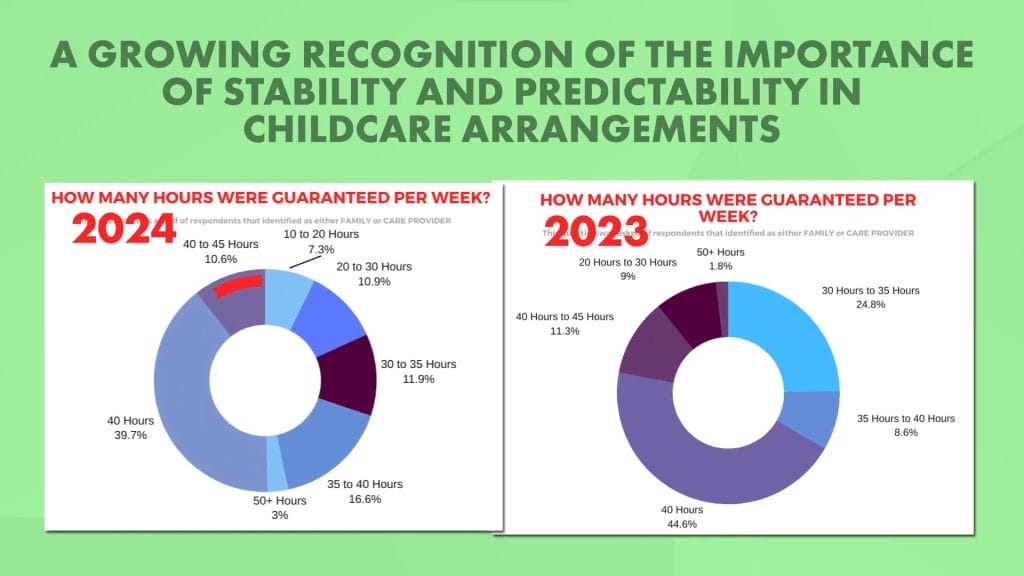
Some nannies consider guaranteed hours as important as the hourly rate, or even more important. Guaranteed hours are not a general Washington statutory requirement, but they are one of the strongest and most consistent nanny-industry standards. Virtually every experienced nanny NPC works with expects them for recurring employment, even when the job is only 10 hours per week.
Here is how guaranteed hours work. Imagine that a nanny is scheduled from 10:00 a.m. to 5:00 p.m., Monday through Friday. On Thursday evening, the family announces that it is leaving for the coast and will not need care on Friday. Under a guaranteed-hours agreement, the nanny is still paid for the seven scheduled hours on Friday because the nanny remained available and reserved that time for the family.
Guaranteed hours can resemble a salary, but the nanny remains an hourly employee. The agreement establishes a minimum number of paid hours the nanny can rely upon each week. If the nanny works more than the guarantee, those additional hours are paid, including overtime when applicable.
Predictability matters. A nanny cannot build a stable monthly budget if income falls every time the family travels, a grandparent visits, a parent takes a day off, or the family decides it does not need care.
Family test: If the nanny is willing and able to work, but the family chooses not to use the scheduled care, the guaranteed hours generally still apply.
Overtime and legal payroll are not optional preferences
For a typical live-out nanny, hours worked beyond 40 in a seven-day workweek must generally be paid at no less than 1.5 times the regular rate. Families should not average hours across multiple weeks or assume that paying a fixed weekly amount eliminates overtime. Narrow exceptions can apply to casual babysitters and certain live-in arrangements, so families with unusual schedules should obtain individualized payroll or legal guidance.
Nannies are also generally household employees, not independent contractors. The IRS explains that a worker is a household employee when the family controls not only what work is performed but how it is performed. The IRS specifically uses a recurring in-home childcare arrangement as an example.
For 2026, families that pay a household employee at least $3,000 in cash wages generally enter the Social Security and Medicare tax system and must issue a W-2. The employer’s share of Social Security and Medicare taxes is 7.65%, before federal unemployment tax, Washington obligations, payroll-administration costs, or other expenses.
NPC continues to see more professional nannies insist upon legal W-2 employment. That is a healthy development. Legal payroll creates employment records, supports access to Social Security and Medicare credits, and helps protect both parties from the financial and legal risks of an under-the-table arrangement.
How much paid time off should a family offer?
Washington generally does not require employers to offer vacation time. Within the professional nanny market, however, paid time off is a well-established expectation.
Based on current Puget Sound placements, NPC commonly recommends:
- Approximately two workweeks of PTO annually for a full-time nanny working about 32 hours or more per week
- Approximately one workweek of PTO annually for a part-time nanny working about 20 to 25 hours per week
PTO should correspond to the nanny’s normal schedule. A nanny who regularly works 32 hours per week would receive approximately 64 hours for two weeks of PTO. A nanny working 25 hours per week would receive approximately 25 hours for one week of PTO.
The employment agreement should explain how PTO is requested, whether any dates are selected by the family, whether unused PTO carries forward, and what happens when employment ends. Clarity prevents both parties from discovering different assumptions after the nanny has already started.
Paid holidays: choose them explicitly
The federal calendar includes 11 recurring holidays, but families do not need to offer all 11 as paid nanny holidays. Washington does not generally require private employers to offer holiday pay.
In the current Puget Sound nanny market, NPC commonly sees:
- Five to eight paid holidays for full-time nanny positions
- Three to five paid holidays for part-time nanny positions
A paid holiday generally applies when it falls on a day the nanny would normally work. The family and nanny should identify the exact holidays in writing rather than referring vaguely to “major holidays.” One person’s expected list may not match another’s.
This is also an area where careful listening matters. If a nanny says that Independence Day, Thanksgiving, and Christmas are particularly important, the offer letter should either include them or clearly address the difference before the nanny is asked to sign.
Washington paid sick leave is required
Washington employees, including household employees in ordinary nanny arrangements, generally accrue at least one hour of paid sick leave for every 40 hours worked. This requirement applies regardless of whether the employee is full-time, part-time, temporary, or seasonal.
The leave is paid at the employee’s normal hourly rate. It becomes usable no later than 90 calendar days after employment begins, and balances of 40 hours or less must carry over to the next accrual year. Employers must also provide required notice and regular information about the employee’s sick-leave balance.
Families frequently omit sick leave from nanny job descriptions because they assume PTO covers everything. A combined PTO policy may satisfy the law only if it meets Washington’s accrual, use, carryover, notice, and other requirements. Families should confirm the structure with their payroll provider.
Do not hide this benefit: Experienced candidates increasingly look for explicit confirmation of Washington paid sick leave. Listing it shows that the family understands its responsibilities.
Mileage reimbursement and work-related driving
Families do not ordinarily reimburse a nanny for the normal commute between the nanny’s home and the family’s home. Reimbursement becomes relevant when the nanny uses a personal vehicle for family-directed driving during working hours, including school transportation, appointments, activities, classes, parks, and other outings.
NPC recommends using the current IRS business-mileage rate as the benchmark. The IRS made an unusual midyear adjustment in 2026: the rate was 72.5 cents per mile from January through June and increased to 76 cents per mile beginning July 1.
Mileage is separate from direct family expenses. Parking, tolls, admission charges, supplies, and purchases made on the family’s behalf should be addressed separately so the nanny is not personally financing the family’s activities.
A thoughtful extra: If the nanny regularly transports the children in a personal vehicle, consider a professional or mobile vehicle-detailing package as a birthday or holiday gift. It is not a required benefit, but it recognizes the real mess and wear that can come with using a personal car for childcare.
Optional benefits that can help an offer stand out
Optional benefits should strengthen a solid package, not distract from missing fundamentals. A healthcare stipend cannot make up for an uncompetitive rate, and a continuing education allowance cannot replace guaranteed hours.
Healthcare support
Healthcare stipends are not yet a Puget Sound industry standard, but NPC occasionally sees families offer approximately $50 to $250 per month to help offset a nanny’s healthcare expenses. Cash stipends may be taxable depending on how they are structured, so families should coordinate with a household payroll or tax professional.
Continuing education
Continuing education support is less common but can be valuable when it aligns with the job. Families sometimes pay for CPR or first-aid recertification, child-development training, newborn education, safety courses, or another relevant credential. This investment can support the nanny’s career while directly improving the care the family receives.
Raises and bonuses
There is no standard annual raise percentage. NPC has seen families offer an additional $1 per hour, a cost-of-living adjustment, improved benefits, or performance bonuses ranging from a few hundred dollars to a few thousand dollars.
A nanny who has performed well will reasonably hope to see some recognition when the agreement is renewed. An annual review gives both parties an opportunity to discuss performance, accomplishments, new responsibilities, the children’s changing needs, market conditions, schedule, benefits, and compensation.
Families should also know that a promised or formula-based bonus may affect the regular rate used to calculate overtime, while a truly discretionary bonus may be treated differently. A payroll professional can help classify it correctly.

The 10% rule: a better way to plan your benefits budget
When families focus only on the hourly rate, paid time off and other benefits can feel like surprise costs. NPC uses a simple planning rule: take the nanny’s hourly rate and add approximately 10% when estimating the core benefits package.
| Nanny’s hourly rate | Approx. 10% allowance | Benefits-planning rate |
|---|---|---|
| $25.00 | $2.50 | $27.50 |
| $30.00 | $3.00 | $33.00 |
| $32.00 | $3.20 | $35.20 |
| $35.00 | $3.50 | $38.50 |
| $40.00 | $4.00 | $44.00 |
The additional allowance helps a family plan for guaranteed hours, PTO, paid holidays, and accrued sick leave. It is a rule of thumb, not a legal formula, and it is not the family’s total employment cost.
Employer payroll taxes, unemployment taxes, payroll-service fees, overtime, mileage, healthcare support, education, bonuses, and other job-related costs may need to be added separately. Employer Social Security and Medicare taxes alone are generally 7.65% once the federal household-employment threshold is reached.
Budget before interviewing: If you believe you can afford a nanny at $30 per hour, begin with a benefits-planning rate of approximately $33 per hour, then add payroll taxes and any job-specific expenses.
Related resource: What Does a Nanny Really Cost in Seattle?
Why strong candidates decline otherwise good offers
A compensation package is often only as competitive as its weakest major component. NPC has seen excellent candidates decline high-paying jobs because the family did not offer adequate PTO or paid holidays. We have also seen candidates reject generous benefits packages because the underlying hourly rate was not competitive.
Families should separate the package into three categories:
- Legal requirements: proper household-employee treatment, overtime when applicable, and Washington paid sick leave
- Industry-standard expectations: competitive pay, guaranteed hours, PTO, paid holidays, and mileage reimbursement for work-related use of a personal vehicle
- Optional enhancements: healthcare support, continuing education, raises, bonuses, and thoughtful extras
Increasing the hourly rate may not overcome missing guaranteed hours. Adding extra PTO may not overcome a rate below the nanny’s requirements. A strong offer works because its major pieces support one another.
How to build an offer that gets a yes
The most effective strategy is also the most human: listen to the nanny.
Candidates will usually tell a family what matters to them, but families sometimes concentrate so heavily on determining the pay rate that they miss other priorities. Before preparing the offer, confirm the nanny’s expectations regarding pay, guaranteed hours, schedule, start date, PTO, holidays, sick leave, overtime, driving, reimbursement, and payroll.
Then build an offer letter that accurately reflects the conversation and invites discussion.
Suggested offer language: We prepared this offer based on everything we discussed. Please review it carefully and let us know if any part does not reflect your understanding or if there is anything you would like to discuss.
One recurring breakdown in the nanny industry is that a family views the offer as a starting point while the nanny assumes it is final. The nanny may reject it without explaining that only one detail is wrong. The issue could be the start date, a schedule detail, a missing guaranteed-hours provision, or a holiday the nanny specifically requested.
An offer letter should create clarity, not end the conversation. Careful listening and an explicit invitation for feedback can prevent an excellent placement from falling apart over one fixable misunderstanding.

Is your nanny offer competitive?
Use this checklist before sending an offer:
- The hourly rate reflects the nanny’s experience, credentials, the number and ages of children, the schedule, location, and responsibilities.
- The position includes a clearly stated number of guaranteed hours.
- Overtime is defined for hours worked beyond 40 in the workweek, when applicable.
- The nanny will be treated as a household employee and paid legally.
- The PTO amount is stated in hours or workweeks and matches the nanny’s regular schedule.
- Every paid holiday is named.
- Washington paid sick leave is included and administered correctly.
- Mileage and direct job-related expenses are addressed.
- The start date, schedule, responsibilities, and compensation match what was discussed.
- The nanny is explicitly invited to ask questions or discuss inconsistencies.
- The family has budgeted beyond the hourly rate for benefits, payroll taxes, and other employment costs.
If you cannot check every applicable box: Resolve the missing issue before presenting the offer. Strong candidates often have multiple opportunities and may interpret an incomplete package as evidence that the employment relationship will remain unclear.
How Nanny Parent Connection can help
Families do not have to build the compensation package or navigate the hiring process alone.
- Concierge Service: NPC helps the family develop a competitive package before launching the position, personally interviews candidates, and manages the search and hiring process.
- Jobs Board and Member Search: families recruiting independently can reach Puget Sound care providers, while NPC helps strengthen the job description and offer.
- Nanny Pay Calculator: families and nannies can use NPC’s calculator to evaluate a fair starting range for a specific position.
- Member guidance: NPC members can ask practical questions about compensation, benefits, and the competitiveness of a position.
- Background checks: families that have selected a nanny can complete comprehensive screening before employment begins.
The right compensation package does more than help a family hire a nanny. It sets expectations, reduces preventable conflict, improves retention, and establishes the employment relationship as the professional partnership it should be.
If you are preparing to hire, begin by deciding what your family can sustainably offer, then compare that package with what experienced candidates in your market expect. The strongest offer is not necessarily the one with the highest hourly rate. It is the one that is complete, clear, competitive, and built around an honest conversation with the nanny you hope will say yes.
Want Help Building an Offer Great Nannies Will Take Seriously?
Nanny Parent Connection’s Concierge Service helps Puget Sound families build a competitive compensation package, create the job description, recruit qualified candidates, and navigate the hiring process from beginning to end.
Hiring independently? Use our Nanny Pay Calculator, post your position to the Jobs Board and Member Search, or order a comprehensive background check when you are ready to hire.
Frequently asked questions
What is a competitive nanny rate in Seattle in 2026?
NPC most commonly sees approximately $30 to $35 per hour for many standard Puget Sound positions, but experience, credentials, children, schedule, location, and duties can move the rate below or above that range.
Are guaranteed hours required by Washington law?
Guaranteed hours are not a general Washington statutory requirement, but they are a firmly established nanny-industry standard for recurring positions.
How much PTO should a nanny receive?
NPC commonly sees two workweeks annually for full-time nannies and one workweek for part-time nannies, calculated using the nanny’s regular weekly hours.
Does a nanny earn Washington paid sick leave?
Yes, household employees in ordinary nanny arrangements generally accrue at least one hour for every 40 hours worked, subject to Washington’s use, notice, and carryover rules.
What is the 2026 nanny mileage-reimbursement rate?
NPC recommends the IRS business-mileage benchmark. It increased from 72.5 cents per mile to 76 cents per mile on July 1, 2026.
Is a nanny a W-2 employee or an independent contractor?
A nanny working in a family’s home under the family’s direction is generally a household employee. Families should review IRS Publication 926 and consult a household payroll professional.
This article provides general educational information and market guidance, not individualized legal, tax, or payroll advice. Requirements can vary based on the employment arrangement and location. Families should consult qualified household-employment, payroll, tax, or legal professionals regarding their circumstances.